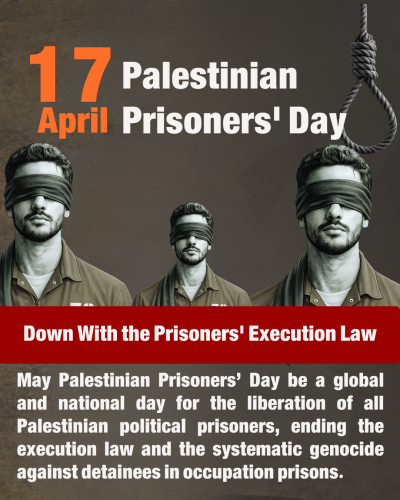
Palestinian Prisoners’ Day 2026
April 14, 2026
Palestinian Prisoners’ Institutions and National and Islamic Forces
For 52 years, April 17 has stood as a defining moment in Palestinian national consciousness. Palestinian Prisoners’ Day is not merely commemorative—it is a unifying act of struggle rooted in a long history of resistance to violent settler-colonialism. It reaffirms our political prisoners as the vanguard of the fight for freedom and dignity.
On this day, memory becomes political action. The prisoners’ cause is not only recalled, but asserted as a universal struggle for justice and liberation. This year, it coincides with the 24th anniversary of the arrest of Marwan Barghouti, and the 38th anniversary of the martyrdom of Khalil al-Wazir—two enduring symbols of Palestinian resistance.
The new law enabling the execution of Palestinian political prisoners marks a dangerous escalation in the architecture of colonial violence. It does not create violence—it legalizes it. By cloaking execution in law, it formalizes murder as state policy and advances a system that codifies Palestinian killing. Explicitly discriminatory, the law targets Palestinians alone, embedding racialized violence within a fully institutionalized legal framework.
For decades, Israeli occupation prisons and military detention camps have functioned as sites of systematic abuse—torture, denial of medical care, isolation, and starvation deployed within an organized regime of criminality. This law deepens that regime, reinforcing a broader process of destruction that operates not only through direct killing, but through the deliberate erosion of the conditions necessary for life.
This is not a rupture, but a consolidation. Extrajudicial executions—through assassinations, field killings, and slow death in prison—have long defined the reality for Palestinians. What this law does is codify and expand those practices, granting them explicit legislative authority and sharpening their lethality.
Despite the ongoing failure and complicity of the international human rights system to halt crimes of genocide—across the occupied territories, and within prisons—the struggle continues. The voices of Palestinian prisoners—men, women, and children—will not be silenced. Their cause remains central to the broader fight for freedom and self-determination.
We call on our people and all those committed to justice worldwide to act—to mobilize, to organize, and to escalate pressure to overturn this law. Let Palestinian Prisoners’ Day be reclaimed as a day of action: to demand the liberation of political prisoners, to reject execution as policy and end the execution law, and to confront the system of destruction imposed upon them. Let it stand as a renewed national and global call: for freedom, for justice, and for an end to the machinery of murder.
***********