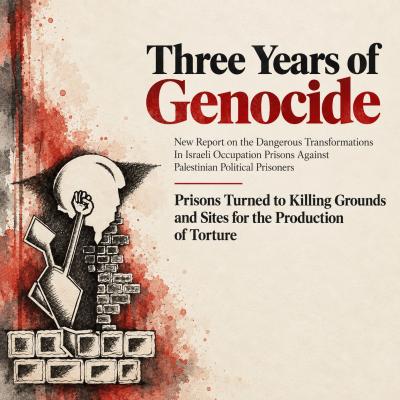
ON THE GLOBAL DAY OF ACTION AGAINST ISRAEL’S ATROCITIES, Addameer Prisoner Support and Human Rights Association welcomes any initiative aimed at ending the occupation and dismantling the system of apartheid, and we call for systemic accountability for genocide, war crimes, and crimes against humanity committed by Israel.
For three years, Israel has been committing genocide against Palestinians, with 73,000 Palestinians killed, including more than 18,000 children, and approximately 70 percent of all structures and buildings in Gaza damaged or destroyed.
According to the latest available figures, approximately 9,265 Palestinian prisoners are currently being held. Of these, 3,101 are administrative detainees held without charge or trial, while a further 1,419 are classified as “unlawful combatants.” Taken together, these categories account for nearly half of the total number of Palestinian prisoners, raising serious concerns about arbitrary and indefinite detention without the basic safeguards of due process.
Particular concern must also be raised regarding the detention and targeting of medical personnel, journalists, and human rights defenders. Their detention is especially alarming given the protected and essential roles they play in providing medical care, documenting violations, and defending fundamental human rights. Such practices contribute to a broader pattern of arbitrary detention and repression against Palestinian civilians and civil society.
Moreover, these concerns are compounded by the continued practice of enforced disappearance involving prisoners from the Gaza Strip. The occupying authorities have persistently withheld significant information concerning the detainees and, in certain instances, have disseminated misleading information about their whereabouts and status.
Moreover, over the past three years, Israeli detention facilities have become sites of severe and systematic violations against Palestinian prisoners. These abuses include physical and psychological torture, deliberate medical neglect, starvation, sexual violence, solitary confinement, and the denial of basic human rights.
This has had a devastating human cost. Since 1967, a total of 329 Palestinian prisoners have died in Israeli detention. At least 92 of these deaths have occurred since 7 October 2023, according to the latest available figures, including 53 prisoners from the Gaza Strip. However, the true figure is probably even greater, considering the ongoing practice of enforced disappearance by the Israeli occupation against numerous prisoners from the Gaza Strip, whose fates remain uncertain to this day
Torture and Ill- treatment
Since 7 October 2023, there has been a marked escalation in reports of torture and ill-treatment, with the daily conditions imposed on Palestinian prisoners themselves becoming forms of punishment and abuse. This has included widespread and systematic repression during prison raids and searches, in which prisoners have been subjected to severe beatings, kicking, and assault with batons, rifle stocks, and other implements. Prisoners have also reported attacks by dogs, deliberate deprivation of food and water, systematic humiliation, prolonged solitary confinement, denial and neglect of medical care, and other forms of cruel, inhuman, and degrading treatment. Together, these practices have had severe consequences for the physical and psychological well-being of prisoners.
Torture in Israeli prisons and detention facilities has been documented across all stages of the detention process, from arrest and interrogation to confinement, imprisonment, transfer between facilities, and, in some cases, release. Addameer and other human rights organizations have documented methods of interrogation and abuse including violent shaking, prolonged placement in painful stress positions, covering detainees’ heads with bags, exposure to loud music or other extreme sensory conditions, fingernail extraction, confinement in cramped spaces, severe beatings, and other forms of physical and psychological coercion aimed at obtaining confessions or otherwise breaking the detainee
These practices are not mere isolated events; instead, they represent a persistent and systematic policy that has evolved over decades. Following 7 October 2023, innovative and unprecedented forms of torture have been utilized, marked by extreme brutality and a calculated intention to cause enduring physical and psychological damage. Testimonies from prisoners reveal that certain practices have resulted in lasting medical repercussions, such as chronic physical injuries, neurological issues, and significant psychological disorders, the impacts of which persist beyond the duration of incarceration.
Systematic Sexual Violence Against Palestinian Prisoners
Since the onset of the genocide, there has been a marked escalation in sexual violence perpetrated against Palestinian prisoners. Numerous Palestinian prisoners have faced sexual crimes, including rape, sexual harassment, strip searches, verbal abuse, threats of rape, and targeted beatings in sensitive areas.
These actions are not mere isolated incidents or exceptions; they are part of a larger strategy of punishment and domination. It is crucial to recognize that sexual violence in prisons is neither a new nor an abrupt occurrence; it is a deeply entrenched practice that has evolved alongside the very creation of the detention system. This indicates a persistent pattern in the application of violence, especially sexual violence, as a means of control, oppression, and breaking the spirit, rather than being the result of random individual actions.
Addameer has documented 41 cases of sexual violence, and the actual number is likely much greater. The cases reported by Addameer included individuals of all ages: men, women, and children. For children, the sexual abuse they endured was primarily confined to strip searches. Women faced this invasive procedure repeatedly, first at the detention site, then at Hasharon Prison, and subsequently at Damon Prison, in addition to experiencing both sexual and verbal harassment. Men, on the other hand, were not only subjected to forced nudity but also faced rape and targeted violence against sensitive areas through beatings, restraints, and burning, particularly during interrogations and crackdowns executed by the repression units at the Sde Teiman Detention Camp and in interrogation centers.
In 2026, the United Nations Secretary-General included the Israeli armed and security forces in the UN’s list of parties credibly suspected of committing or being responsible for patterns of rape or other forms of sexual violence in situations of armed conflict. The listing reflects documented patterns of sexual violence against Palestinians, including in detention, and further underscores the scale and gravity of these violations.
“Death Penalty for Palestinians” Law
Today, as we mark the World Day Against the Death Penalty, we reaffirm that the right to life must be protected for all, and that the death penalty has no place in a justice system committed to human rights and dignity.
This principle is particularly urgent in light of the escalating violations against Palestinian prisoners and detainees in Israeli prisons and detention centers. On 30 March 2026, the Knesset passed, during its second and third readings, a law that imposes the death penalty on Palestinians who deliberately cause the death of Israelis. This legislation has lowered the legal requirements for issuing a death sentence, enabling judges to impose it with a simple majority rather than the unanimous consent previously required in capital punishment cases, as dictated by military orders in the occupied territory.
In this scenario, two distinct legal pathways have been established; the first is a military law that applies to Palestinians living in the Palestinian territory occupied since 1967, while explicitly excluding settlers. This creates a framework of institutionalized racial discrimination and a dual legal system. Under this military law, the death penalty is nearly obligatory, as it cannot be reduced to life imprisonment, nor can prisoners receive pardons. As a result, the law removes judicial discretion, permitting military courts to convert the death penalty to life imprisonment only in rare and exceptional circumstances, for reasons that remain unspecified and undefined. The second pathway is a civil track that applies to Palestinians who possess Israeli citizenship, while excluding Israelis by tying the punishment to ideological motivations. This law requires the death penalty for premeditated murder committed with the intent of denying the existence of the State of Israel. In these instances, civil courts must impose one of two penalties: death or life imprisonment.[1]
The legally mandated method of execution is death by hanging, executed by specially trained prison guards who possess complete immunity from prosecution. Their identities are kept strictly confidential, and revealing any information about them constitutes a crime punishable under the penal code. The execution will take place within 90 days of the sentence being issued. The Prime Minister has the authority to request a delay for special circumstances, as long as the postponement does not exceed 180 days. Following sentencing, the condemned prisoner will be segregated from other prisoners who are not facing the death penalty. The victim's family will be allowed to attend both the court proceedings and the execution, whereas the prisoner's family will be prohibited from attending.[2]
In relation to prisoners from the Gaza Strip, the Knesset plenum approved a bill on 11 May 2026, during its second and third readings, aimed at prosecuting individuals referred to as "participants in the October 7 massacre." According to the bill, indictments would be directed to a specialized military court established under the Defense Regulations. This court would have jurisdiction over offenses under any relevant law, including severe crimes such as genocide, breaches of state sovereignty, waging war, assisting the enemy, and terrorist acts as defined by the 2016 Counter-Terrorism Law.
Furthermore, the bill outlines the formation of a special judicial panel that includes a retired judge from a central court and the establishment of an appeals process. The procedures and evidentiary rules utilized in civilian courts would be applied, with exceptions specified in a separate appendix. The court would also be empowered to operate under extraordinary circumstances. Furthermore, the proposal encompasses regulations regarding the holding, broadcasting, and recording of public hearings, in accordance with laws established by regulation.[3]
On this day, we therefore call for the protection of the right to life, accountability for violations against prisoners and detainees, and full respect for international human rights and humanitarian law.
Lack of Accountability
The evidence and documented testimonies presented in Addameer’s documentation reveal a deeply entrenched pattern of impunity surrounding violations against Palestinian prisoners. The documented abuses—including torture, medical neglect, cruel and degrading treatment, unlawful killings, and sexual abuse—are compounded by the persistent failure to ensure meaningful accountability for those responsible.
Rather than constituting merely isolated violations, these practices are presented as occurring within a legal and institutional framework that has enabled alleged perpetrators to evade effective scrutiny, prosecution, and legal consequences. The absence of an absolute domestic prohibition on torture, together with the recognition of exceptional circumstances such as the so-called “ticking time bomb” scenario, has created legal space for practices that would otherwise constitute serious violations of fundamental rights. Furthermore, the judiciary’s role in upholding or permitting certain contested practices has further weakened mechanisms of accountability and contributed to the normalization of impunity.
Consequently, the central concern extends beyond the occurrence of individual violations to a broader structural failure to investigate, prosecute, and punish those responsible. This persistent failure of accountability reinforces a system in which serious violations can occur without effective consequences, depriving victims of meaningful access to justice and redress while undermining the protection of their rights to life, physical integrity, and human dignity.
Demands and Recommendations
- End the Israeli occupation immediately, in accordance with the Advisory Opinion from the International Court of Justice regarding the Legal Consequences of Israeli Policies and Practices in the Occupied Palestinian Territory.
- Release all Palestinian prisoners and detainees without arbitrary restrictions or conditions, and end practices of detention that deny detainees basic guarantees of a fair trial.
- Mobilize international pressure on governments to adopt concrete political, economic, and diplomatic measures, including targeted sanctions, aimed at ending serious violations of international law.
- Call for effective international criminal accountability for crimes committed against Palestinian prisoners, including through the ongoing jurisdiction and investigative mechanisms of the International Criminal Court, with a view to investigating war crimes and crimes against humanity and, where the applicable legal threshold is met, other international crimes.
- Call for a comprehensive and coordinated international boycott of Israeli state institutions and entities directly supporting or facilitating the occupation and documented violations of international law, extending across political, diplomatic, economic, academic, cultural, sporting, and institutional spheres.
- Urge States Parties to the Geneva Conventions to fulfill their obligations to ensure respect for international humanitarian law, including by taking appropriate measures to prevent and respond to serious violations affecting Palestinian prisoners.
[1] The Palestinian Center for Israeli Studies – Madar. "Laws drafted and proposed for execution that are discriminatory, targeting only Palestinians while exempting Jews." 31 March 2026. https://tinyurl.com/yxvkfptt
[2] Ibid.
[3] The Knesset. "The Knesset approves, in second and third readings, a bill concerning the trial of those accused of committing the events of the October 7, 2023 massacre." 12 May 2026. https://tinyurl.com/u4bv5e2j