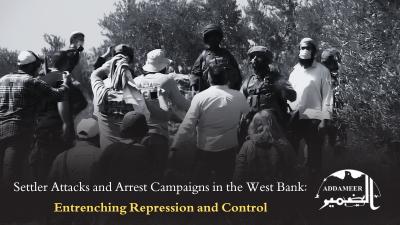
Settler Attacks and Arrest Campaigns in the West Bank: Entrenching Repression and Control
The West Bank has recently witnessed a noticeable escalation in settler attacks, particularly in the months following the genocidal war against the Palestinian people. These attacks have become one of the most prominent features of daily life in many Palestinian villages and towns. They range from physical assaults, arson of property, and the destruction of agricultural lands, to theft and direct attacks on residents. These practices do not end with property damage; their impact extends to the social and security fabric of these areas, especially amid the deaths of Palestinians and dozens of injuries resulting from the growing settler violence.
In the midst of these attacks, arrest campaigns that follow them stand out as one of the most present issues in the Palestinian landscape of the occupied West Bank. This occurs particularly in light of the selective application of law and the lack of accountability practiced by the occupation authorities over many years. In many Palestinian villages, the pattern is almost identical: an attack begins with settlers assaulting Palestinian homes, land, or vehicles, followed by military intervention by the Israeli army, which often ends with the arrest and prosecution of Palestinians themselves under various security pretexts, without any accountability for the attacking settlers.
Settler practices across most areas of the West Bank are embodied through a recurring mechanism that begins with attacks carried out by settler groups against Palestinian citizens and their property. These assaults are often carried out under military protection, with the army either providing cover for the attackers or intervening later in their favor. As tensions escalate and residents attempt to defend themselves or their property, occupation forces intervene by launching arrest campaigns targeting Palestinians exclusively, including those who were attacked or those present to defend their land. This pattern is repeatedly observed across different governorates.
This methodology reveals a deeply entrenched policy by the occupation authorities of double standards; whereby military power is used to entrench the outcomes of settler attacks rather than prevent them. Palestinians are pursued and arrested under broad security claims immediately after the attack ends. This practice effectively shields settler groups from accountability and places Palestinians in a dual confrontation: first with settler violence, and then with detention by the occupation authorities, thereby reinforcing a system that holds Palestinians responsible for the violence committed against them.
In this context, according to data from the Negotiations Affairs Department of the Palestine Liberation Organization[1], occupation forces carried out more than 1,550 raids across various parts of the Palestinian territories during April. Most of these raids were concentrated in cities and towns in the West Bank and Jerusalem, alongside approximately 170 closures of crossings and main entrances, and the establishment of around 502 sudden military checkpoints. These measures severely restricted the movement of citizens and deepened paralysis in daily life between Palestinian cities and villages.
This escalation was accompanied by a widening of arrest campaigns, with field monitoring recording more than 665 arrests during April across the West Bank and Jerusalem. This came amid ongoing daily raids and repeated clashes and assaults, particularly in areas that witness settler attacks or direct confrontations with occupation forces.
Various reports issued by United Nations bodies indicate that during April 2026, settlers carried out no fewer than 200 attacks in the West Bank. These resulted in the killing of several Palestinians, injuries to others, and significant damage to homes and infrastructure.
The impact of these policies is not limited to the security dimension alone; it directly affects the daily lives of Palestinians, especially in villages located near settlements and outposts. Residents in these areas now live in a constant state of anticipation and fear, amid increasing nighttime attacks, home invasions, assaults on agricultural lands, and livestock theft. This has created a pressing reality that pushes many families to reduce their farming activities or avoid accessing their land for fear of attack or arrest.
In the village of Al-Mughayyir, northeast of Ramallah, this situation is clearly reflected in the escalating settler attacks alongside repeated arrest campaigns targeting residents. The United Nations Office for the Coordination of Humanitarian Affairs (OCHA) documented 17 settler attacks against the village from the beginning of 2026 until April, averaging about five incidents per month. This represents a steady increase compared to the previous three years, when the monthly average ranged between one and two incidents.[2]
According to a member of the village council speaking to Addameer Prisoner Support and Human Rights Association, April 2026 alone witnessed 25 arrests among the village’s residents, with around 15 released while 10 remain in detention, including four children. All detainees were arrested following settler attacks on them or their property near the village. He notes that Al-Mughayyir has for years lived under continuous pressure due to its proximity to several active settlement outposts, making attacks a near-daily feature of life. Residents now understand that any confrontation with settlers, even when defending land, livestock, or homes, may result in arrest or nighttime home raids.
In one such incident, a 24-year-old woman (A.N.) recounts being assaulted while returning to Al-Mughayyir on 13 April 2026. She says she was driving from the village of Abu Falah when she was stopped in the Marj Si‘ area by a Border Police unit accompanied by two female soldiers and a settler grazing sheep nearby. She states that the settler immediately assaulted her upon stopping, slapping her in the face, before the soldiers joined in, physically attacking her, forcing her to the ground, detaining her for half an hour by the roadside, and insulting her after she attempted to defend herself. She notes that the military force intervened to protect the settler rather than prevent the assault.
In another incident, a 47-year-old man (R.A.) describes the arrest of his 22-year-old son, who was detained from the family home on 30 April 2026 at 1:30 a.m. He explains that the arrest followed a series of events in which settlers, accompanied by police, attempted to seize the family’s livestock and assaulted his son when he tried to prevent them and protect the animals. He adds that occupation forces later stormed the home and arrested his son on charges related to assaulting a soldier and a settler. The son remains in detention awaiting trial. The family has since lived in constant anxiety due to the lack of clear information about his fate or the duration of his detention, emphasizing that he was only trying to protect the family’s livelihood.
Another resident (A.A.), aged 56, lives with his family in a house near the “Allon Road” on the outskirts of Al-Mughayyir. He says the family has suffered repeated settler attacks for years, despite the home being officially licensed. He recalls a large-scale attack on 12 April 2024, when around 700 settlers stormed the area in an attempt to force the family to leave. Since then, attacks have continued almost constantly.
He adds that the family remains in a permanent state of alert, especially at night, fearing new attacks on the house or livestock. His children, he says, are increasingly reluctant to move freely around the area due to fear of assault or detention by soldiers who are continuously present.
He further recounts that on 13 December 2025, he and his three sons were arrested by occupation forces on allegations of poisoning sheep belonging to a settler grazing near their home. They were transferred between multiple interrogation and detention centers, and one of his sons remains in administrative detention for six months. The family, he says, still struggles to understand how it shifted from being a victim of repeated attacks to being treated as a target of arrest and investigation.
Al-Mughayyir is not an exceptional case. Similar accounts are repeated across numerous Palestinian villages from the north to the south of the West Bank, where settler attacks are almost consistently accompanied by military raids and arrest operations targeting Palestinians themselves. In many cases, confrontations that begin as assaults on land or homes are transformed into security files used to justify further restrictions on residents.
This reality deepens the sense of insecurity among citizens, particularly in rural areas that rely heavily on agriculture and livestock as their main source of income. Farmers who once went daily to their land now weigh the risk of attack or arrest before doing so, while families face increasing difficulty maintaining their social and economic stability under ongoing threats.
Repeated arrest campaigns also leave profound social and psychological impacts on Palestinian society, particularly when they target children or occur during nighttime home invasions. These raids have become routine scenes for many families, marked by fear and constant anxiety, amid the absence of real guarantees preventing their recurrence.
These testimonies reflect the reality experienced by many Palestinian villages in the West Bank, where settler violence is frequently accompanied by military measures targeting Palestinians themselves. This dynamic deepens the sense of insecurity and absence of justice, turning daily life into a continuous state of threat and anticipation, amid growing fears that this pattern will continue and expand across the West Bank.
Addameer calls on the international community and human rights and humanitarian organizations to fulfill their legal and moral responsibilities regarding the escalating settler attacks against Palestinians in the West Bank, and the accompanying arrest campaigns systematically targeting Palestinian citizens.
Addameer further emphasizes the urgent need to provide international protection for Palestinian civilians and to end the policy of impunity entrenched by the occupation authorities through ignoring settler violence and arresting Palestinians instead of holding perpetrators accountable. It also stresses the importance of launching independent international investigations into violations committed against Palestinians, including physical assaults, forced displacement, and arbitrary arrests that have become part of daily life in many Palestinian villages and towns.
[1] Palestinian Negotiations Affairs Department, Monthly Report for April 2026, 2026, available at:
https://www.nad.ps/ar/violations-reports/%D8%A7%D9%84%D8%AA%D9%82%D8%A7%D8%B1%D9%8A%D8%B1-%D8%A7%D9%84%D8%B4%D9%87%D8%B1%D9%8A%D8%A9/%D8%A7%D9%84%D8%AA%D9%82%D8%B1%D9%8A%D8%B1-%D8%A7%D9%84%D8%B4%D9%87%D8%B1%D9%8A-%D9%84%D8%B4%D9%87%D8%B1-%D9%86%D9%8A%D8%B3%D8%A7%D9%86-%D8%A5%D8%A8%D8%B1%D9%8A%D9%84-2026
[2] United Nations Office for the Coordination of Humanitarian Affairs occupied Palestinian territory (OCHA OPT). (2026, May 2). Humanitarian Situation Report | 1 May 2026. https://www.ochaopt.org/content/humanitarian-situation-report-1-may-2026.