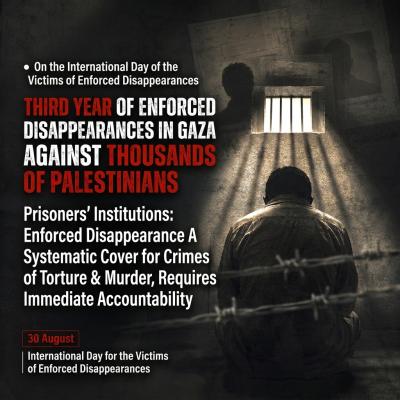
On the International Day of the Victims of Enforced Disappearances
- Third Year of Enforced Disappearances in Gaza Against Thousands of Palestinians
- Prisoners’ Institutions: Enforced Disappearance A Systematic Cover for Crimes of Torture & Murder, Requires Immediate Accountability
August 30, 2026
Ramallah, occupied Palestine – On the International Day of the Victims of Enforced Disappearances, Palestinian prisoners’ institutions affirm that the Israeli occupation authorities continue, for the third consecutive year, to use “enforced disappearance” as a systematic policy against thousands of Palestinian detainees abducted from the Gaza Strip, who were arrested during the years of the crime of genocide. The fates and places of detention of a large number of them remain unknown to this day.
The institutions stress that the occupation’s continued withholding of information about detainees, its refusal to disclose their names, places of detention, and health conditions, and its denial of their ability to communicate with their families, lawyers, and human rights organizations do not constitute merely isolated violations of detainees’ rights. Rather, they form an integrated system of forced disappearance, used to strip detainees of legal protection and create conditions conducive to torture, ill-treatment, medical crimes, and other violations, away from oversight and accountability.
Enforced Disappearance: A Crime in Its Own Right and a Cover for Other Crimes
Enforced disappearance is absolutely prohibited under international law and cannot be justified under any circumstances, including war or armed conflict. The International Convention for the Protection of All Persons from Enforced Disappearance defines it as the deprivation of liberty followed by a refusal to acknowledge the deprivation of liberty or by concealment of the fate or whereabouts of the disappeared person, which places such a person outside the protection of the law.
International law also recognizes the right of victims and their families to know the truth and the fate of their loved ones, as well as their right to remedy and compensation. The Rome Statute of the International Criminal Court classifies enforced disappearance, when committed as part of a widespread or systematic attack directed against a civilian population, as a crime against humanity.
Since the beginning of the crime of genocide in the occupied Gaza Strip, occupation authorities have used legal and military measures to entrench this policy, including the detention of thousands of civilians without adequate safeguards, reliance on the “unlawful combatant” law, and the establishment of special detention camps, in addition to imposing extensive restrictions on access to detainees by lawyers, the International Committee of the Red Cross, and human rights organizations.
Thousands Forcibly Disappeared… While the Fate of Hundreds Remains Unknown
To this day, there is no accurate and comprehensive statistic on the number of Palestinians subjected to enforced disappearance in the occupied Gaza Strip, amid the difficulty of documenting cases and determining the fate of detainees and missing persons. This difficulty has been compounded by the scale of destruction, killings, and forced displacement, the targeting or obstruction of search-and-rescue teams, as well as the occupation’s deliberate policy of withholding information about detainees and missing persons.
Over the past three years, prisoners’ institutions have undertaken efforts to investigate and obtain information about the fate of thousands of Palestinians abducted from the occupied Gaza Strip. Occupation authorities responded that they had no information about hundreds of those reported missing. Later, photographs emerged of some of these individuals whom the occupation authorities had previously denied arresting or detaining. In other cases, following legal efforts and petitions to the occupation’s Supreme Court, the occupation army was compelled to acknowledge that it was holding the bodies of detainees, without providing dates or circumstances surrounding their martyrdom.
In this context, the case of journalist and martyr Ehab Diab from the occupied Gaza Strip stands out. Over the past period, several institutions continued their efforts to uncover his fate and received several responses from authorities stating that no information was available about him. Eventually, one human rights organization in the 1948-occupied territories petitioned the Supreme Court, and it was subsequently revealed that his body was being held by the army. The institutions later announced his fate on August 9, 2026, stating that he had been killed inside the occupation’s prisons, without specifying an exact date of his martyrdom.
Enforced Disappearance as a Tool for Torture and Killing
The forcible disappearance of a detainee from the outside world cannot be separated from the system of violations to which they are subjected inside detention facilities. The absence of information, as well as legal and human rights oversight, creates an environment conducive to the perpetration of crimes away from the eyes of the world.
Through the testimonies and statements they have managed to collect, the institutions have documented that detainees abducted from the Gaza Strip have been subjected to brutal practices from the moment of their arrest and throughout interrogation and transfer to prisons and detention camps. These practices include, most notably, systematic torture, ill-treatment, and medical crimes, which have resulted in the martyrdom of dozens of detainees.
In this context, occupation authorities established camps and detention facilities specifically for detainees abducted from Gaza, most notably the ‘Sde Teiman’ military camp, along with the ‘Anatot,’ ‘Ofer,’ and ‘Naftali’ military camps. They also reopened the ‘Rakefet’ section—a section located within Ramla Prison. After the institutions were able to visit detainees from the occupied Gaza Strip held in these facilities, they reported shocking and horrific testimonies and accounts.
Withholding Bodies: An Extension of the Crime of Concealing Peoples’ Fates
The policy of concealment does not stop with those who are alive. The occupation authorities continue to withhold the bodies of Palestinians from the Gaza Strip, including detainees who were martyred in prisons and detention camps, in addition to continuing to hold the bodies of other Palestinians in morgues and in what are known as “cemeteries of numbers.”
The withholding of bodies and the refusal to return them to their families constitute a violation of the right of victims and their families to know the truth and to recover the bodies of their loved ones and bury them in a manner that preserves their human dignity. It also raises serious concerns regarding the circumstances and causes of death and obstructs the conduct of independent and transparent investigations.
A Legal and Military System to Entrench Enforced Disappearance
Palestinian prisoners’ institutions affirm that the crime of enforced disappearance was not carried out randomly or as a result of individual abuses. Rather, it was entrenched through a system of military and judicial orders, legislation, and practices that provided a framework for the detention and disappearance of thousands of Palestinians.
The occupation’s judicial system has played a role in entrenching this policy by treating the “unlawful combatant” law as a framework for detaining Palestinians from the Gaza Strip, while the occupation authorities have refused to disclose sufficient information regarding the numbers, identities, and places of detention of those held. Human rights organizations have also filed petitions with the Israeli Supreme Court seeking disclosure of the identities and places of detention of detainees; however, these legal proceedings have not brought the policy of enforced disappearance to an end.
According to figures released by the occupation’s Prison Service up to the beginning of August 2026, the number of individuals classified by it as “unlawful combatants” stood at 1,358. Meanwhile, the number of identified Palestinians abducted from the Gaza Strip, and who were martyred in detention stands at 53, out of a total of 99 prisoners and detainees who were martyred following the genocide and whose identities are known.
International Responsibility Intensifies in the Face of the Ongoing Crime of Genocide
The continuation of enforced disappearance against Palestinian detainees, alongside the ongoing crime of genocide, places the international community under a direct legal and moral responsibility, particularly as families continue to be deprived of their most basic rights: knowing the fate of their loved ones and their whereabouts.
Accordingly, Palestinian prisoners’ institutions call on the international community, the United Nations, and its human rights mechanisms to assume their legal and moral responsibilities and move beyond silence and formal condemnation toward binding measures that reveal the fate of those subjected to enforced disappearance, guarantee international and lawyers’ access to detainees, launch independent investigations into the crimes of enforced disappearance, torture, and killing, hold those responsible accountable, and compel the occupation to hand over the bodies of the martyrs being held.
The continued concealment of the fate of hundreds is not merely an information gap; it is a systematic crime being committed before the eyes of the world, while the failure and silence of the international human rights system have become a cover for impunity.
Limiting the response to documentation and statements while the crimes continue makes this system a partner in perpetuating the absence of accountability. Therefore, ending enforced disappearance and revealing the fate of detainees is not a humanitarian demand that can be postponed; it is a genuine test of the international community’s commitment to enforcing the law and rescuing humanity from the ongoing path of genocide.
(ends)