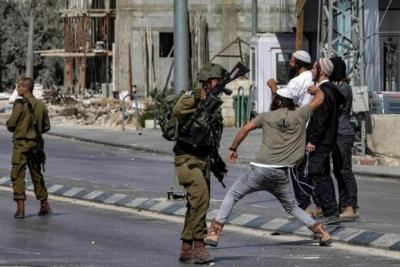
Photo: Watan Agency
Between Settler Violence and Widespread Raids
An Escalating System of Arrest and Collective Punishment
Since the beginning of Israel’s genocidal war against the Palestinian people in October 2023, the West Bank has witnessed an escalation in raids and arrest campaigns carried out by Israeli occupation forces. These operations have taken on a broad and systematic character, targeting Palestinian cities, refugee camps, and villages. They have been accompanied by raids on homes and facilities, area closures, the imposition of military restrictions, and the expansion of arrest and detention practices, within the context of an ongoing escalation of Israeli policies of control and repression in the Occupied Palestinian Territory.
At the same time, the West Bank has witnessed an escalation in settlement activity, including the establishment of settlement outposts and the expansion of existing settlements, alongside an increase in settler attacks against Palestinians, their property, and agricultural lands. Examining these developments within their broader temporal and political context reveals two parallel tracks: a security and military track based on raids, arrests, detention, and military restrictions; and a settlement track based on the expansion of settlements and outposts, land seizure, and escalating settler violence. These practices form part of the broader context of Israel’s ongoing war against Palestinians, making the West Bank part of the interconnected landscape of the war rather than a separate arena.
This overlap is particularly evident in recent developments in the West Bank, where escalating settler attacks have coincided with military operations, raids, and widespread arrest campaigns carried out by occupation forces in several Palestinian areas.
Against this backdrop, this paper examines two examples of recent developments in the West Bank. The first concerns the raid on Qalandia Refugee Camp and the accompanying widespread arrest campaign, while the second concerns the campaign targeting the village of “Tell” following an escalation in settler attacks, and the military measures and arrests that followed.
Raid on Qalandia Refugee Camp and Mass Arrest Campaign
In the early hours of Wednesday, 5 August 2026, Israeli occupation forces began a large-scale raid on Qalandia Refugee Camp, north of occupied Jerusalem. The operation lasted approximately 46 hours and ended with the withdrawal of the forces in the early hours of Friday. During this period, the forces imposed a siege on the camp and closed its entrances, deployed throughout its neighborhoods and surrounding areas, and carried out a series of raids and arrests in an operation characterized by its broad scope, prolonged duration, and the multiple accompanying measures imposed on residents.
According to information collected in the field, approximately 60 people were arrested during the raid, including children and a woman. The majority of those arrested were released during the raid or in the following days. However, two former prisoners and a woman remained in detention. The woman was subsequently released on bail, while the two former prisoners remained detained at the time this paper was prepared.
The operation was not limited to arrests. It was accompanied by a range of military and security policies and measures inside the camp. Occupation forces closed the entrances and restricted residents’ movement, surrounded a number of homes, and raided others, using them as temporary military positions and locations for interrogation and detention. Some families were forced to evacuate their homes during the raid, while others remained trapped inside for long periods, amid the deployment of soldiers and snipers around homes and on the rooftops of some buildings.
The operation focused primarily on field arrests and interrogations inside homes. Testimonies indicate that residents were detained and restrained inside homes and courtyards before being transferred to military barracks or houses that had been converted into temporary detention sites. The interrogations were accompanied by widespread violations, including beatings, threats with weapons, verbal abuse, and keeping detainees restrained for prolonged periods.
Testimonies also documented the use of physical violence during interrogation and detention, including beatings with hands, feet, rifle butts, and sticks; painful restraints; threats to kill or harm family members; and other degrading treatment. Some testimonies concerned children and minors, including reports of the beating and interrogation of a 16-year-old minor despite soldiers being informed of his age.
The testimonies further indicate that the raid was not limited to individuals targeted for arrest but extended to their family members. Relatives of detainees were subjected to beatings, threats, and questioning, while women and children were exposed to violent incidents during home raids. Threats directed at family members were also used to pressure detainees during interrogation.
Another notable policy during the raid was the seizure of homes and their conversion into military positions. Soldiers took control of a number of homes and occupied them for extended periods, establishing interrogation and detention points inside them. Residents reported the destruction of household contents and the ransacking of furniture, appliances, and food supplies, in addition to the seizure of personal belongings and money.
Occupation forces also imposed extensive restrictions on movement and access to medical services. The closure of entrances and deployment of forces throughout the camp made it difficult for ambulances and medical teams to reach injured persons. Some residents were forced to use side roads to reach people in need of medical care. The siege also restricted access to food, water, and basic necessities, as families remained inside their homes for prolonged periods and were unable to leave to obtain essential supplies.
The case of Tareq Ayyad illustrates the nature of these practices. According to his testimony, occupation forces raided his home at approximately 1:30 a.m. on Thursday and assaulted members of his family before restraining, interrogating, and repeatedly beating him. The soldiers also took his 16-year-old son, detained and interrogated him, and assaulted him despite knowing that he was a minor. Ayyad stated that the assault against him continued during interrogation and was accompanied by threats with weapons and pressure to provide information. His home was searched and damaged, and some of his belongings were confiscated. After the soldiers withdrew, Ayyad remained restrained inside the house until volunteers were able to bring an ambulance to him via a side road and transfer him to hospital.
Field findings indicate that the consequences of the operation extended to the entire family and community environment. The closure of the camp, raids on homes, and forced evacuations deprived residents of essential services and transformed the area into a besieged environment in which arrests and coercive practices continued.
Tell Village – Mass Arrests Following Settler Attacks
What took place in Tell village, southwest of Nablus, following the events of 24 July 2026 represents another example of the intersection between settler violence and military operations carried out by occupation forces in the West Bank. The widespread arrest and raid campaign targeting the village followed attacks carried out by settlers against residents and their property. The events resulted in the killing of four Palestinians, alongside reports of the killing of a settler and a soldier.
Following the events, occupation forces carried out a large-scale nighttime raid on the village, including home raids, the detention of residents, and mass arrests. According to testimonies collected from a number of detainees and the head of the Tell Village Council, between 20 and 30 residents were arrested, while approximately 80 people were subjected to field detention for varying periods. The arrests also included an injured man who was receiving treatment at a hospital in Nablus, along with his brother.
Testimonies indicate that the arrests were not limited to individuals present in the vicinity of the events, but extended into homes and targeted members of the same family, including sons and children. Several civilian homes were also converted into military detention sites, where detainees were taken after being handcuffed and blindfolded, before some were subsequently transferred to military camps and detention centers.
Field testimonies indicate that the campaign involved a range of violations accompanying arrest and detention, including prolonged handcuffing and blindfolding; deprivation of food, water, sleep, and access to toilets; forcing detainees to remain in painful physical positions; beatings, humiliation, and threats; as well as depriving some detainees of medication and medical care despite their need for it.
The testimony of detainee Bassam Al-Saifi illustrates some of these practices. He reported that occupation forces took him to a house that had been converted into a military barracks, where his hands were restrained and his eyes blindfolded, before he was transferred to a camp whose location was not disclosed to him. According to his testimony, he remained there for two days outdoors, with his hands tied and his eyes blindfolded, lying on asphalt and gravel under the sun.
During his detention, Al-Saifi stated that he was deprived of food, water, sleep, and access to a toilet. Detainees were forced to sit for prolonged periods in the same position, with their hands tied behind their backs and their heads lowered. He also reported that detainees were beaten when they spoke or objected, and said that one soldier stepped on his head when he attempted to change his sitting position because of pain and numbness.
Al-Saifi’s testimony highlights serious health and procedural violations during his four-day detention. He reported being deprived of his regular medication for heart disease and high cholesterol and receiving no medical care. Al-Saifi confirmed that he was released without undergoing any formal interrogation, being informed of a specific charge, or being brought before judicial authorities.
This testimony reveals a clear gap between arrest as a measure targeting a specific individual and the manner in which the campaign was carried out at the village level. Residents were detained in their homes, transferred to military sites, and subjected to harsh detention conditions, without, in some cases documented through the testimonies, any actual interrogation taking place.
The testimony of resident Khaldoun Asida further reinforces this pattern. He reported that occupation forces raided his home and asked about his sons before arresting the father and his two sons together and taking them to a house that had been converted into a military barracks. According to his testimony, the detainees were handcuffed and blindfolded, and each was assigned a serial number upon arrival at the site, indicating the large number of detainees gathered there.
Asida further reported that the arrest of his family members was not accompanied by any interrogation concerning the events. Instead, the treatment consisted primarily of threats. His brother, who was arrested later in the same area, was subjected to beatings, humiliation, and shouting alongside a number of other detainees.
The documented testimonies confirm that the practices employed during the campaign in Tell village constitute a clear violation of the prohibition of collective punishment under international humanitarian law. These violations included mass arrests, the conversion of homes into military sites, handcuffing and blindfolding, and the deprivation of medication and medical care. The comprehensive nature of these measures, including the siege and targeting of families with no apparent connection to the events, further reinforces the characterization of the measures as collective punishment against the civilian population.
These measures coincided with an Israeli political and military escalation in the West Bank following the events of 24 July. Israeli official discourse focused on the killing of Israelis during the events, without, according to the monitoring conducted, referring to the attacks carried out by settlers against residents of the village prior to the confrontations. Raids, arrests, and intensified movement restrictions in “Tell” and its surrounding areas continued thereafter.
In this context, the case of Tell village cannot be separated from the broader pattern examined in this paper: the escalation of settler violence and settlement activity in parallel with the expansion of military operations, arrests, and restrictions imposed on Palestinian communities. The significance of this case lies particularly in the fact that the arrest campaign followed events that began with settler attacks, after which the village became the site of a military operation, mass arrests, and measures affecting a broader range of people than those directly connected to the events.
The two documented cases of Qalandia Refugee Camp and Tell village reveal a shift from arrests as measures targeting specific individuals to broad operations with collective effects, including the arrest of people from their homes, multiple members of the same family, minors, and groups subjected to mass field detention. The operations were also not limited to arrests, but were accompanied by sieges, area closures, movement restrictions, home raids, and the conversion of homes into military barracks and detention centers.
The testimonies demonstrate that military raids have become a tool for controlling civilians, through subjecting residents to a military presence inside their neighborhoods and homes, restricting their movement, and limiting their access to food, water, and medical care. The testimonies also indicate the use of beatings, threats, humiliation, restraints, and deprivation of sleep, food, water, and medication, transforming detention beyond mere deprivation of liberty into a set of practices affecting detainees, their families, and their wider communities.
More broadly, the two cases reveal a recurring pattern combining incursions, sieges, arrests, detention, ill-treatment, and the temporary seizure of homes, alongside the continued expansion of settlements and escalation of settler violence. These practices therefore warrant legal assessment in light of the rules of international humanitarian law, particularly those concerning the protection of civilians, safeguards for detainees, and the prohibition of collective punishment.
In light of the escalating pattern of systematic violations, Addameer Prisoner Support and Human Rights Association affirms that the fundamental means of stopping these violations and ending the prevailing climate of impunity is to end Israel’s occupation of the Occupied Palestinian Territory, in compliance with the decision of the International Court of Justice affirming the illegality of the continued occupation and the obligation to bring it to an end. Addameer calls on the international community and the High Contracting Parties to the Geneva Conventions to uphold their legal and moral responsibilities and work to ensure implementation of the decision, and to take the necessary measures to end the unlawful situation arising from the continued occupation. Such measures must bring an end to policies of arrest, collective punishment, raids, and attacks against Palestinians, and ensure respect for and protection of the rights of the Palestinian people in accordance with international law.